

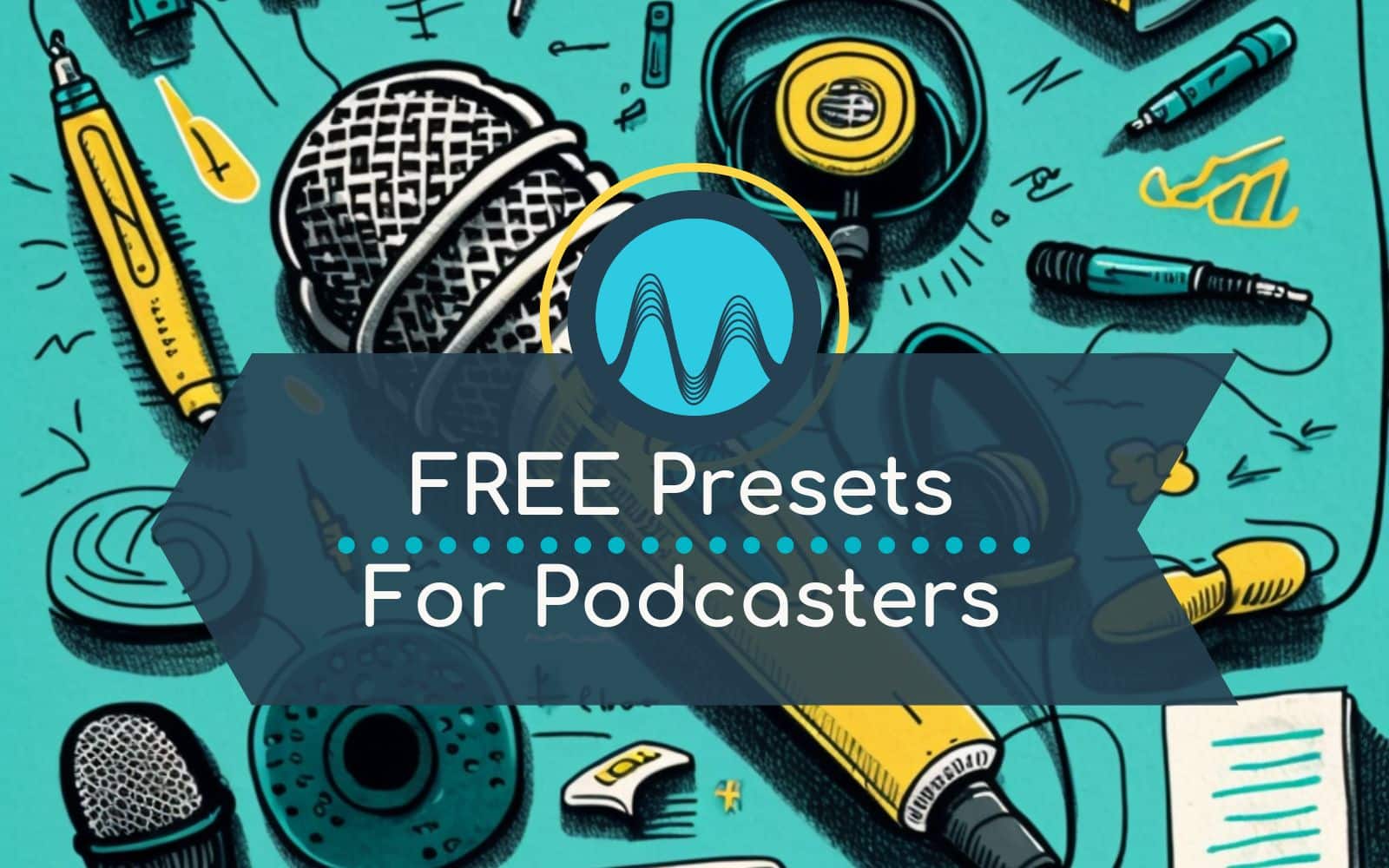
Are you looking for a great sound on your podcast? You find it’s a little too much tweaking for your comfort zone? You’ve come to the right place! We share with you our template for recording a podcast to use inside Adobe Audition. Just open, drag and drop.
Adobe Audition can be a little overwhelming. We have been asked time and time again to provide easy and free solution to a great sound. Your recording is good but lacks that little special sparkle. Those presets are the answer.
Why Do Podcasters Need Presets?
Podcasters can use presets in Adobe Audition for a number of reasons:
- Consistency: Using presets can help ensure that audio levels, equalization, and other processing are consistent from episode to episode. Which can improve the overall listening experience for your audience.
- Time-saving: Setting up audio processing can be time-consuming. However, using presets can streamline the process, allowing you to focus on creating content rather than adjusting settings.
- Repeatability: Presets make it easy to repeat a specific audio processing chain. Even if you make changes to the original settings! This can be particularly useful for podcasters who want to apply the same effects to multiple segments or episodes.
- Convenience: With presets, you can quickly apply commonly used processing chains with a single click. Without having to go through the process of adjusting settings each time.
Overall, using presets in Adobe Audition can help podcasters to produce high-quality audio more efficiently and consistently, which can improve the overall quality of their podcast and make the production process smoother and more streamlined.
Free Podcast Presets For Adobe Audition
Based on the “Podcast Host” preset from our best selling Pro Podcast Presets. This is a lite version adapted to the free edition. You’ll get a “Podcast Regular” and “Podcast Heavy” track that will be everything you need for a one person record and edit podcast.
The “Podcast Regular” track will be enough for most users but “Podcast Heavy” can add more processing power when you most need more clarity and punch to a voice.
How To Download The Presets?
Simply add your email address in the form below, the link will appear on this page once you submitted the form.
How To Save Presets As a Template?
Here is a short video showing you how to save ANY presets inside Adobe Audition.
Advanced Presets For Podcasters
Need more tracks, want to fix audio issues, add music with auto-ducking, looking for EQ and compression designed for popular podcast microphones? All this and more included in our Pro Podcast Presets v3.0.

“The amount of time you safe is way higher than the purchase price – compared in financial value. If your budget is small – as is ours, too, try to safe other expenses. Tell family and friends about your dream so they might understand and support you (even more). Or start a crowdfunding campaign. Believe me, you don’t want to miss it anymore, once you work with it.
Markus Symeon Blum




Download button/link not showing.
Already working. Thanks
Thank you
I love what you doing Mark and Izz. Keep it up.
Thanks so much Stan!
I love what you doing Mike and Izz. Keep it up.
Very good
I love what you doing brad Keep it up.
Very Good ????
i like it
fantastic tutorials, I have learned a lot from you, Sir.
i cannot see the download link after filling in the form
It does appear in place of the box that you fill in your information on. Works just fine 🙂
thanks
where is the link ?!!
It appears in place of the box. It does work – just checked 🙂
You may want to change the Download link to blue/ something else, just to make it more visible to people ;D
Wanted to try this out for audition. Can’t wait to see the results!
nice
Thank you for the presets
I did not receive the link
The link is not emailed – it’s displayed on the screen once you submit your details 🙂 Hope this helps!
Thank you for the presets 🙂
i am excited to see how this works
Great job explaining the template!
Great!
good
Definitely not seeing a link to this FREE download. Hmm maybe it’s a matter of filling out this form – Hitting “Post comment”
It’s fixed now! Please try again 🙂
Thanks
Nice!
Hello Izabela, most likely is a problem with my browser, but the form filled is not appearing anymore, it is my understanding that the link should appear there. Could you please email it to me, if it’s not too much bother? Thank you! 🙂
It’s fixed now! Please try again 🙂
Thank you, you are the best! cheer!!
I cannot find the from to filling information to get the download link, it isn’t free anymore?
It’s fixed now! Please try again 🙂
i want to preset
Hello I cant find the link
It’s fixed now! Please try again 🙂
Great!!!
really apreciated from you guys !!! THANK YOU
miss seeing u live folks
ok
i can not found the preset